Western Canada Hydrogen Corridors Initiative
The Western Canada Hydrogen Corridors Initiative (WCHCI) is a plan to decarbonize long-haul trucking while strengthening Canada’s industrial competitiveness, energy security and economy.
Contact the Initiative Team2025-2026
Analysis and engagement phases
Alberta &
British Columbia
Geographic Scope
Class 7 & 8
Heavy-duty freight focus
FCEV, HICE,
Dual-Fuel
Technology assessment
Outcomes & Impact
The WCHCI is designed to support informed decision-making and reduce uncertainty around hydrogen-powered heavy-duty freight deployment by addressing both hydrogen supply and demand together. Through a multi-stakeholder consortium of fleet operators, vehicle manufacturers, hydrogen producers, and distributors, the initiative helps clarify the conditions needed to scale demand, unlock infrastructure investment, and reduce costs over time.
What makes the Western Canada Hydrogen Corridors Initiative different?
Clearer conditions for hydrogen adoption at scale
Addresses hydrogen supply and demand together by assessing vehicles, fueling infrastructure, operations, workforce readiness, and supporting services needed for reliable heavy-duty freight deployment.
Reduced operational and commercial risk
Focuses on de-risking hydrogen operations, safety, supply, and performance by using pilot-at-scale planning to support longer-term adoption, deployment, and commercialization, as infrastructure expands and production scales.
Improved cost and business model visibility
Examines deployment arrangements and commercial models, including options such as pay-per-use and vehicle leasing, to help lower total cost of ownership and support viable fleet transition pathways. Compare the total cost of ownership of heavy-duty trucks using our TCO Calculator.
Evidence to support strategic policy and infrastructure decisions
Provides insights from pilot-at-scale planning to inform public investment, infrastructure planning, and policy alignment that accelerate decarbonization while strengthening energy security and economic competitiveness.
Positioning Western Canada for global leadership
Supports the Edmonton region and Western Canada’s role as a leader in clean freight and hydrogen innovation, building on existing expertise, resources, and a supportive ecosystem.
A complementary approach to clean transportation
Demonstrates how hydrogen mobility works alongside electrification to enable broader, faster decarbonization, support system resilience, and relieve pressure on the electric grid during scale-up.
A coordinated pathway to market development
Addresses the supply-and-demand coordination challenge by convening fleets, manufacturers, producers, and distributors to support infrastructure investment and long-term market viability.
Improved investment readiness and risk reduction
Helps de-risk investment in hydrogen production, transportation, and infrastructure by applying pilot-at-scale analysis to system-level deployment planning.
Long-term economic and industrial opportunity
Supports job creation, sustainable infrastructure development, and broader economic benefits in Western Canada, with a focus on inclusive participation, including Indigenous engagement.
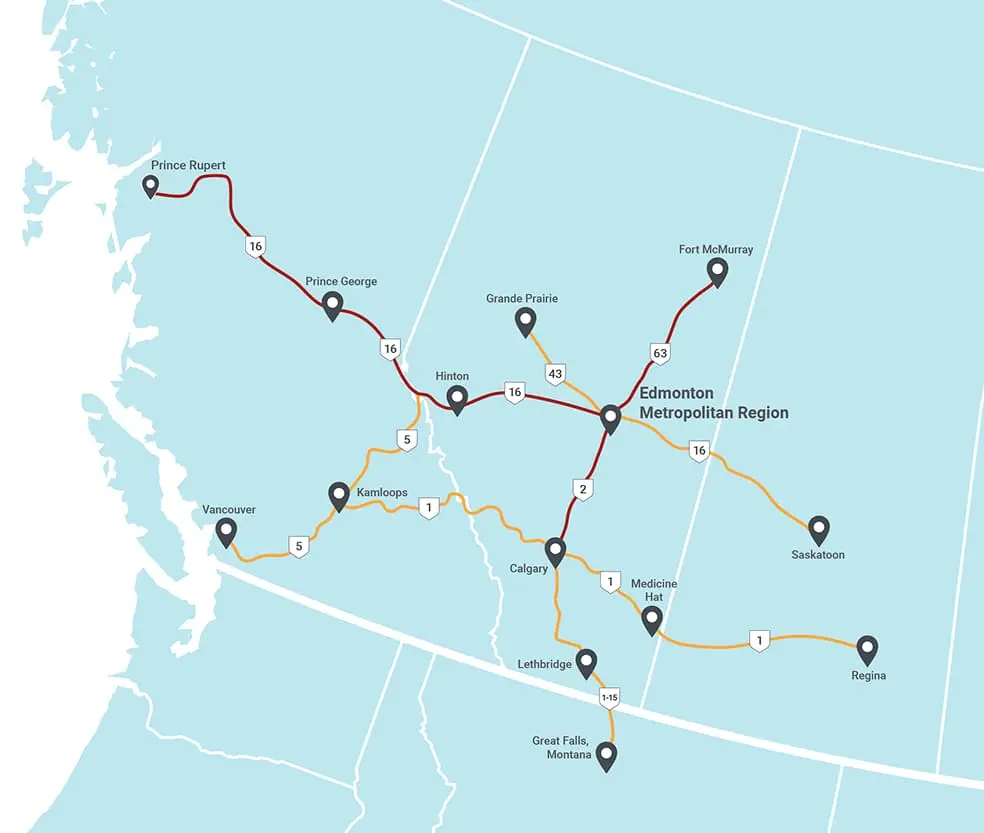
Hydrogen Corridor Overview
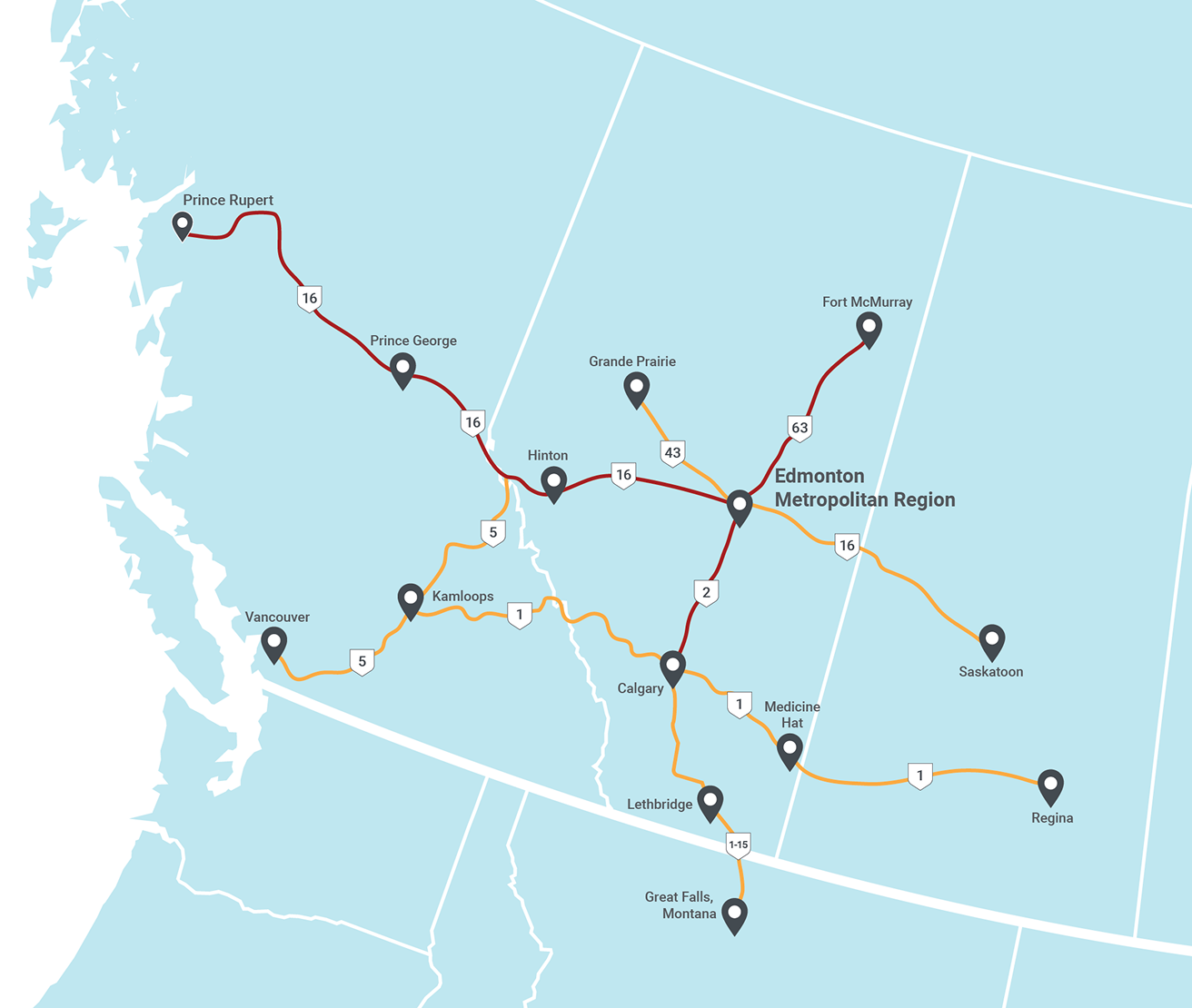
Strategic Routes for Piloting Heavy-Duty Hydrogen Trucks
Priority and secondary routes were identified using a structured, data-informed approach that considers truck freight activity, proximity to hydrogen supply, availability of refuelling infrastructure, and access to maintenance and service support. Together, these routes represent practical conditions for piloting hydrogen-powered heavy-duty freight operations in Western Canada.
LegenD
Priority corridors
- Edmonton to Calgary
- Edmonton to Prince Rupert
- Edmonton to Fort McMurray
Secondary corridor
- Edmonton to Vancouver
- Calgary to Vancouver
- Edmonton to Grande Prairie
- Calgary to Medicine Hat
- Edmonton to Saskatoon
- Calgary to Montana
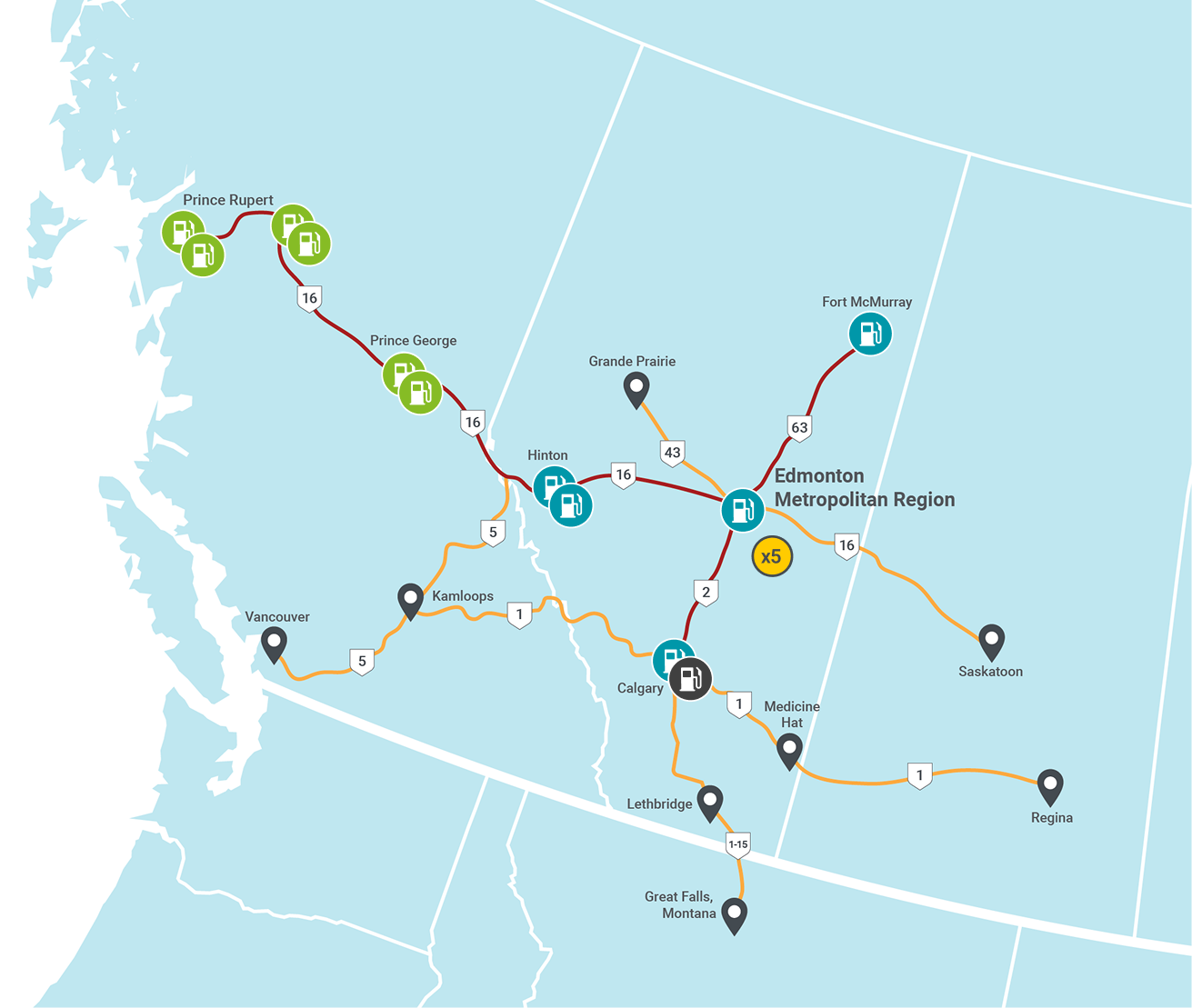
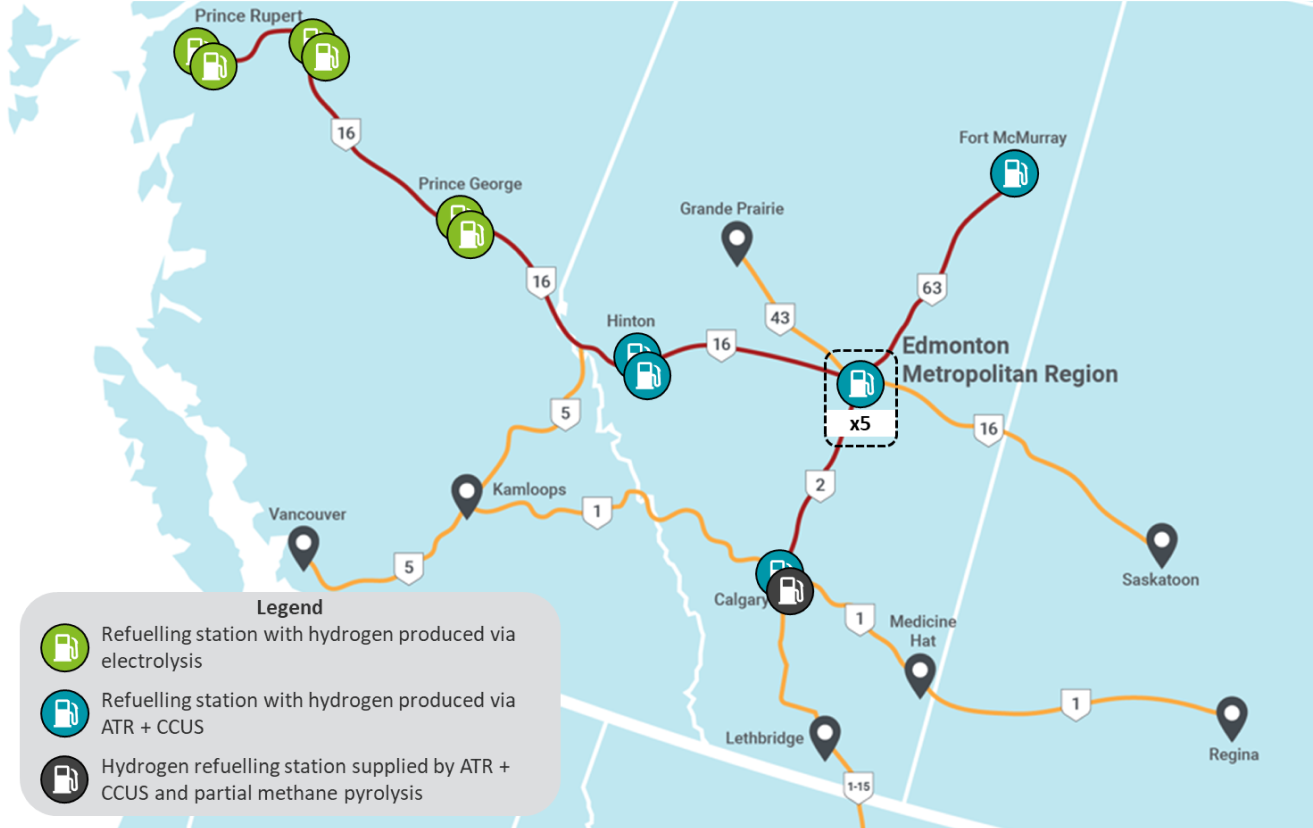
Proposed Hydrogen Refuelling Stations
Proposed refuelling locations illustrate potential hydrogen supply pathways that could support pilot activities along selected routes. Production methods shown are indicative only and do not prescribe final configurations, which will be determined in consultation with partners.
legend
Refuelling station with hydrogen produced via electrolysis
Refuelling station with hydrogen produced via ATR + CCUS
Hydrogen refuelling station supplied by ATR + CCUS and partial methane pyrolysis

Pilot at Scale
What “Pilot at Scale” Means
Pilot at scale is a planning and evaluation approach used to assess hydrogen-powered heavy-duty freight deployment under real-world conditions. It examines operations, safety, hydrogen supply, demand, policy alignment, and system economics together to reduce risk and inform readiness ahead of broader adoption and commercialization.
Current Phase: Stakeholder Engagement
Foundational analysis phase completed Dec 2025.
Stakeholder Engagement Snapshot
Engagements included demand-side fleets, hydrogen supply partners, OEMs, and enabling organizations.
33
organizations approached
Total
stakeholder interviews completed
Commercial Pathways Considered
As part of pilot-at-scale planning, multiple commercial structures were examined to understand how participation, investment, and risk could be aligned across stakeholders.
Shared investment and risk between public and private participants to support infrastructure and deployment.
Usage-based structures designed to reduce upfront costs and support early-stage fleet participation.
Vehicle or infrastructure leasing arrangements to lower capital barriers and increase deployment flexibility.
Key Insights from Stakeholder Engagement
Strong alignment with the initiative’s phased approach
Corridor development viewed as critical
Broad interest across the value chain
Financial support contingent on clarity
Anchor Tenant Potential
Pilot at Scale
What “Pilot at Scale” Means
Pilot at scale is a planning and evaluation approach used to assess hydrogen-powered heavy-duty freight deployment under real-world conditions. It examines operations, safety, hydrogen supply, demand, policy alignment, and system economics together to reduce risk and inform readiness ahead of broader adoption and commercialization.
Learn More or Get Involved
The initiative is advancing through a phased, collaborative process informed by analysis, stakeholder engagement, and pilot-at-scale planning. Detailed findings, modelling assumptions, corridor analyses, and supporting materials are available through a full Project Overview Report.
To request access, learn more about the initiative, or discuss opportunities to get involved, please contact the project team.
Initiative Partners & Contributors
Project Lead


PROJECT FUNDERS


Project Lead


PROJECT FUNDERS


Collaborators & Advisory Committee


Western Canada Hydrogen Corridors Initiative
The Western Canada Hydrogen Corridors Initiative (WCHCI) is a strategic effort to develop hydrogen-powered trucking corridors along key routes in Western Canada. Led in collaboration with industry, government, and research partners, the project aims to accelerate hydrogen-vehicle adoption, reduce emissions, and help build a sustainable hydrogen economy by fostering partnerships across producers, distributors, fleet operators, and end users.
vision and collaboration
Alberta has pioneered pilots that demonstrate the commercial feasibility of heavy-duty hydrogen vehicles. WCHCI will bring together a consortium of partners to advance a hydrogen-vehicle “pilot at scale” in Alberta and British Columbia.


Project Lead


Service Providers


Project funders


Project funders


Project partners


Project advisory commitee


Project advisory commitee


Project advisory commitee
Project objective and approach
What makes the Western Canada Hydrogen Corridors Initiative different?
Novel scope considerations include a system-wide business case to assess opportunity from an investment (as well as total cost of ownership) perspective, three different hydrogen powertrains, and interprovincial route dynamics. A robust project governance framework included real-time input and insights from funders, partners, and the Project Advisory Committee.
Within project scope
Ecosystem partners
- Truck and engine OEMs

- Vehicle dealerships
- Fuel suppliers
- Infrastructure providers
- Government
- Fleets and carriers
- Market enablers
- Investors and financiers
Estimated demand adoption modelling and partner identification
- Projected vehicle demand by fuel type
- Technology costs and TCO analysis
- Policy scenario impact
- Fleet yard analysis
Hydrogen powertrains
- Fuel cell electric
- Dual fuel
- Hydrogen internal combustion
Geographies
- Alberta
- British Columbia
Vehicle classes*
- Class 7
- Class 8
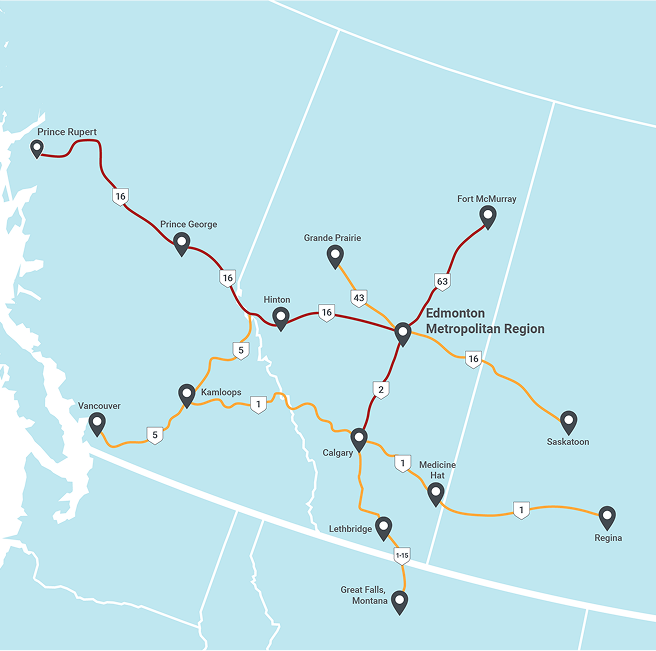
Strategic routes for piloting heavy-duty hydrogen trucks
The classification of high-traffic corridors as priority or secondary was informed by a structured, data-driven methodology that evaluated truck freight volume, potential hydrogen production, availability of fueling stations, and dealer support for maintenance and repairs.
LegenD
Priority corridor
Secondary corridor
Priority corridors
- Edmonton to Calgary
- Edmonton to Prince Rupert
- Edmonton to Fort McMurray
Secondary corridors
- Edmonton to Vancouver
- Calgary to Vancouver
- Edmonton to Grande Prairie
- Calgary to Medicine Hat

- Edmonton to Saskatoon
- Calgary to Montana
- Calgary to Kamloops

What is Pilot at scale?
A pilot at scale emulates the complexities of heavy-duty trucking in a corridor or region by testing the full operational ecosystem. The goal is to accelerate commercial readiness and vehicle adoption. These learnings validate financial assumptions, close data gaps, and inform investment and incentive strategies.
Pilots at scale address challenges…
by coordinating fleets,
partners, and investment…
…to accelerate market readiness and adoption
- Optimal deployment strategy: Identifies best routes and vehicle applications for different hydrogen powertrains
- Funding and business models: Clarifies incentive structures and models that support long-term adoption
- Operational requirements: Highlights workforce skills, emissions performance, and transition readiness needs

- Truck deployment: Pilots deploy 25 to 1,000 trucks, depending on program scale and investment
- Partners: Demand-side (fleets), enabling (governments), and supply-side (OEMs, fuel providers) partners collaborate
- Investment: Funding ranges from $21M o $900M across public and private sources

- De-risking technology adoption: Validating truck performance, fueling reliability, and maintenance needs in realworld conditions
- Building partnerships in the market: Aligning demandside fleets, supply-side OEMs, and enabling partners like governments and utilities
- Accelerating market readiness: Demonstrating operational feasibility at scale to encourage broader industry uptake
Pilots at scale address challenges…
- Optimal deployment strategy: Identifies best routes and vehicle applications for different hydrogen powertrains
- Funding and business models: Clarifies incentive structures and models that support long-term adoption
- Operational requirements: Highlights workforce skills, emissions performance, and transition readiness needs

by coordinating fleets, partners, and investment…
- Truck deployment: Pilots deploy 25 to 1,000 trucks, depending on program scale and investment
- Partners: Demand-side (fleets), enabling (governments), and supply-side (OEMs, fuel providers) partners collaborate
- Investment: Funding ranges from $21M o $900M across public and private sources

by coordinating fleets, partners, and investment…
- De-risking technology adoption: Validating truck performance, fueling reliability, and maintenance needs in realworld conditions
- Building partnerships in the market: Aligning demandside fleets, supply-side OEMs, and enabling partners like governments and utilities
- Accelerating market readiness: Demonstrating operational feasibility at scale to encourage broader industry uptake
Pilot at scale around the globe—what we learned


Before decisions are made about the pilot, we reviewed best practices and interviewed nine pilots at scale.
De-risk investments to incentivize pilot participation
Developing an integrated operational and infrastructure plan
Selecting the project partners and consortium governance structure
Ensuring regulatory alignment for long-term pilot stability
Commercial models de-risk the pilot, support adoption, and align investment
Innovative commercial structures lower upfront costs, enable sustainable funding during the pilot, and reduce complexity for participants.
Sample of innovative commercial models
Truck leasing model
- Third-party leasing avoids large upfront capital costs
- Reduces risk for early adopters; enables trials without full commitment

Pay-per-use model
- Fixed cost per kilometre covering vehicle, fuel, maintenance, and insurance
- Bundling simplifies participation and avoids long-term capital commitments

Public-private partnerships
- Private investors and public institutions jointly fund vehicles and fuelling infrastructure
- Risks and costs are shared across jurisdictions, enabling scale.

160-vehicle pilot

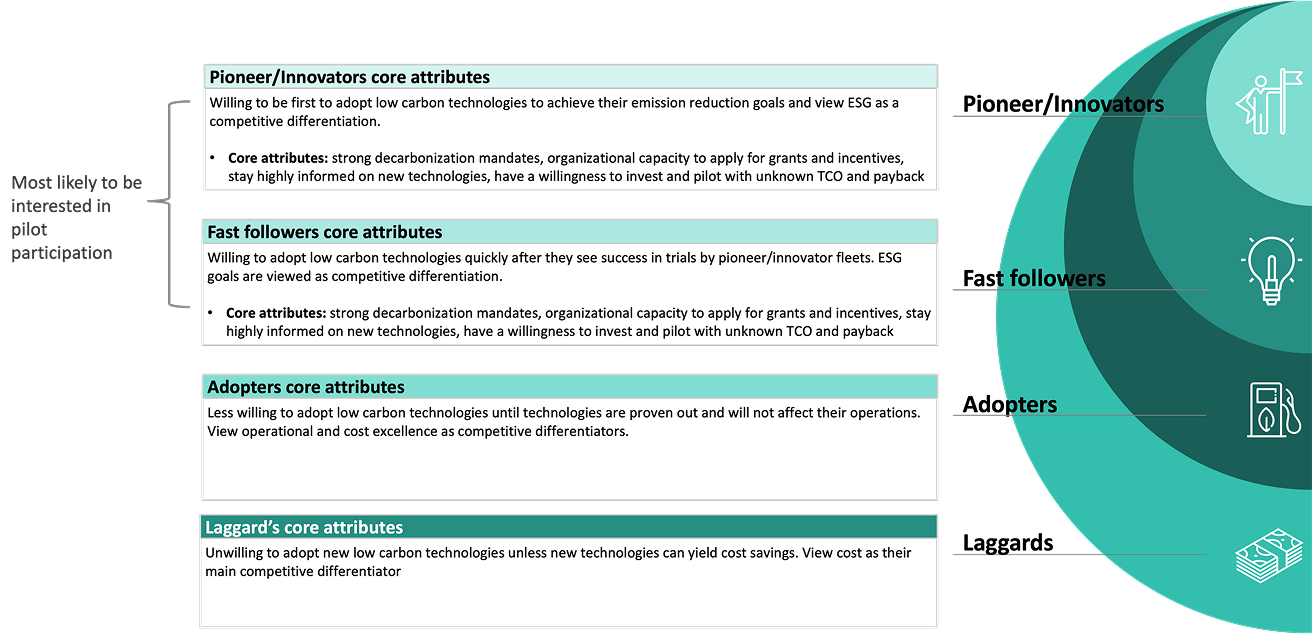
Core attributes of fleet archetypes for hydrogen truck adoption
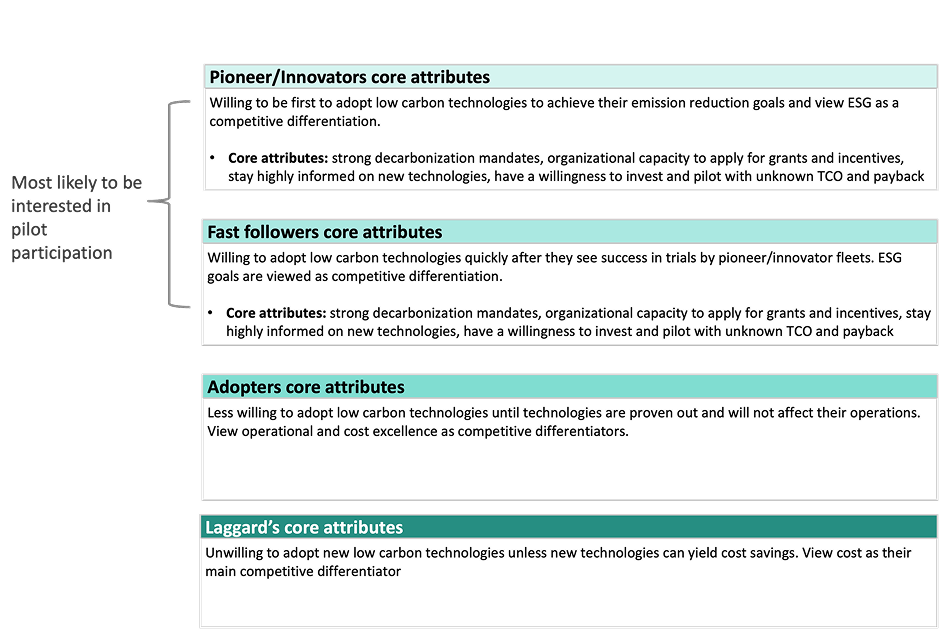
Pioneer/innovator and fast follower fleets were identified as the most likely participants for the WCHCI pilot; 80 fleets were identified who fall into these two fleet archetypes.


Core attributes of fleet archetypes for hydrogen truck adoption (powertrain agnostic)
Understanding fleet archetypes is helpful to classify and conduct outreach to those who have potential characteristics for hydrogen truck adoption like decarbonization mandates, emission reduction targets, and compatible duty cycles.

Identifying first-mover fleets for a potential 160-truck pilot in Western Canada
Pioneer/innovator and fast follower fleets were identified as the most likely participants for the WCHCI pilot; 80 fleets were identified who fall into these two fleet archetypes.

Proposed Pilot Details
Two scenarios were developed. The 80-truck scenario requires 9 stations; the 160-truck scenario requires 16. Federal and potential provincial incentives are key to de-risking early participation.
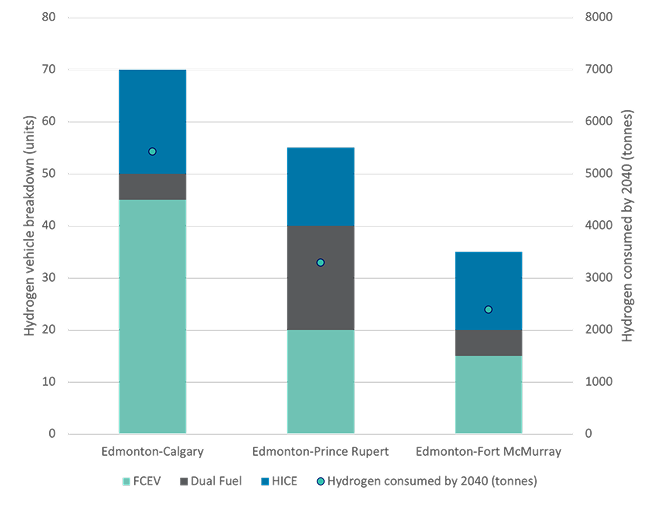
Proposed hydrogen truck deployment by corridor
Corridor
80-vehicle scenario
FCEVs
Dual fuel
HICE
160-vehicle scenario
FCEVs
Dual fuel
HICE
Edmonton-Calgary
20
5
10
45
5
20
Edmonton-Prince
10
5
10
20
20
15
Edmonton-Fort McMurray
10
5
5
15
5
15
Total Trucks
40
15
25
80
30
50
Proposed hydrogen refueling stations by city
The number of stations per location is determined by corridor requirements, ensuring the ratio of trucks to stations aligns with a 1,250 kg station tank size and a 35 kg average fil.
Location
80-vehicle scenario
160-vehicle scenario
Edmonton
3
5
Calgary
1
2
Fort McMurray
1
1
Hinton
1
2
Prince George
1
2
Smithers
1
2
Prince Rupert
9
2
Total stations
9
16
160-Truck Scenario
The classification of high-traffic corridors as priority or secondary was informed by a structured, data-driven methodology that evaluated truck freight volume, potential hydrogen production, availability of fueling stations, and dealer support for maintenance and repairs.
Tech mix: ~50% FCEV, 31% HICE, 19% dual-fuel (2028–2035)
Stations: 16 (~1.25 t/day capacity each)
Vehicle deployment and hydrogen consumption

proposed hydrogen refuelling stations
Note: Hydrogen production methods shown are indicative of potential supply
pathways at each location and are not mandatory for pilot execution. Final
configurations will be determined in consultation with partners.

proposed hydrogen refuelling stations

Note: Hydrogen production methods shown are indicative of potential supply
pathways at each location and are not mandatory for pilot execution. Final
configurations will be determined in consultation with partners.
Overview of Business Case Outputs
Financial Business CasE
Financial, environmental, and social benefits are calculated to identify the potential opportunity for each corridor.
Costs
Capital expenditure - vehicles
$ 58,760,094
Capital expenditure - refueling stations
$ 64,255,605
Operating expenditure - vehicles - fuel
$ 80,351,713
Operating expenditure - vehicles - other vehicle expenses
$ 21,756,479
Operating expenditure - refueling stations
$ 17,311,894
Total costs
$ 242,435,785
Current federal incentives
Capital expenditure - vehicles
$ 26,000,000
Capital expenditure - refueling stations
$ 32,127,803
Operating expenditure - vehicles - fuel
$ 18,454,000
Operating expenditure - vehicles - other vehicle expenses
-
Operating expenditure - refueling stations
-
Total incentives
$ 76,581,802
Theorized additional provincial incentives
Capital expenditure - vehicles
$ 19,500,000
Capital expenditure - refueling stations
-
Operating expenditure - vehicles - fuel
$ 7,671,923
Operating expenditure - vehicles - other vehicle expenses
-
Operating expenditure - refueling stations
-
Total incentives
$ 27,171,923
Net costs
Capital expenditure - vehicles
$ 13,260,094
Capital expenditure - refueling stations
$ 32,127,803
Operating expenditure - vehicles - fuel
$ 54,225,790
Operating expenditure - vehicles - other vehicle expenses
$ 21,756,479
Operating expenditure - refueling stations
$ 17,311,894
Net costs
$ 138,682,059
Overview of business case outputs for priority corridors
Financial, environmental, and social benefits are calculated to identify the potential opportunity for each corridor.
Costs
Capital expenditure - vehicles
$ 58,760,094
Capital expenditure - refueling stations
$ 64,255,605
Operating expenditure - vehicles - fuel
$ 80,351,713
Operating expenditure - vehicles - other vehicle expenses
$ 21,756,479
Operating expenditure - refueling stations
$ 17,311,894
Total costs
$ 242,435,785
Current federal incentives
Capital expenditure - vehicles
$ 26,000,000
Capital expenditure - refueling stations
$ 32,127,803
Operating expenditure - vehicles - fuel
$ 18,454,000
Operating expenditure - vehicles - other vehicle expenses
-
Operating expenditure - refueling stations
-
Total incentives
$ 76,581,802
Theorized additional provincial incentives
Capital expenditure - vehicles
$ 19,500,000
Capital expenditure - refueling stations
-
Operating expenditure - vehicles - fuel
$ 7,671,923
Operating expenditure - vehicles - other vehicle expenses
-
Operating expenditure - refueling stations
-
Total incentives
$ 27,171,923
Net costs
Capital expenditure - vehicles
$ 13,260,094
Capital expenditure - refueling stations
$ 32,127,803
Operating expenditure - vehicles - fuel
$ 54,225,790
Operating expenditure - vehicles - other vehicle expenses
$ 21,756,479
Operating expenditure - refueling stations
$ 17,311,894
Net costs
$ 138,682,059
Canadian dollars
Environmental and Social Business Case
Environmental and social benefits to Western Canada are anticipated to be significant both within the pilot and as markets develop beyond it.
Abated emissions
CORRIDOR
160-vehicle scenario
GHGs (tCO2e)
NOx (kg)
PM (kg)
Finalized results – Environmen
tal and social business case
Environmental and social benefits to Western Canada are anticipated to be significant both within the pilot and as markets develop beyond it.
Key environmental assumptions
The entire lifecycle is considered when calculating the GHG emissions reductions, including:
- Vehicle operations
- Fuel dispensing, production, storage, and distribution
- Feedstock transport, recovery, and upgrading
- Materials in vehicles
- GHG emissions includes CO2, CH4, N2O, CFCs + HFCs, and CO
- Only tailpipe emissions are considered for nitrogen oxides and particulate matter emissions
Abated emissions
CORRIDOR
160-vehicle scenario
GHGs (tCO2e)
NOx (kg)
PM (kg)
Jobs created
Component
160-vehicle scenario
Temporary jobs
Permanent jobs (full-time, 2027 – 2033)
Total
~ 240
~ 19
Opportunity per priority corridor
Edmonton to Calgary
- Represents 44% of pilot trucks
- Supports 45 FCEVs, 5 dual-fuel, 20 HICE, 4 stations
- Purchases: FCEV + dual-fuel from 2028; HICE from 2031
- Cost breakdown (modelled): truck $81M; infrastructure $22M; federal incentives $31M; theorized provincial incentives $13M
- Builds demand certainty for hydrogen supply; signals OEM and service network development
Edmonton to Prince Rupert
- Represents 34% of pilot trucks
- Supports 20 FCEVs, 20 dual-fuel, 15 HICE, 7 stations (heavier dual-fuel use early)
- Launches 2029 Edmonton–Prince George; extends to Prince Rupert by 2031
- Cost breakdown (modelled): truck $48M; infrastructure $49M; federal incentives $32M; theorized provincial incentives $8M
- Backbone for interprovincial freight to B.C. ports; aligns with H2 Gateway growth
Edmonton to Fort McMurray
net cost ~$23 million.
- Represents 22% of pilot trucks
- Supports 15 FCEVs, 5 dual-fuel, 15 HICE, 2 stations
- Purchases: FCEV + dual-fuel from 2030; HICE from 2032
- Cost breakdown (modelled): truck $32M; infrastructure $11M;
federal incentives $14M; theorized provincial
incentives $6M - Supports heavy-haul tied to the regional energy sector; leverages lowcarbon hydrogen production in-region
Pilot roadmap and roll out
The proposed pilot roadmap by phase
The proposed pilot implements a consistent four-phase approach across all three corridors. The start times for each corridor may be staggered, allowing for sequential or overlapping progress as each corridor comes online.
Pre-pilot 2025-2028
Activating the pilot 2028-2030
Scaling the pilot 2030-2032
Operating the pilot 2032-2035
Building blocks of the pilot are being put in place and key pilot decisions are being finalized.
Initial vehicles and infrastructure is becoming operational, and the pilot commences in Edmonton to Calgary corridor, and Edmonton to Prince George via Hinton.
The pilot expands to all priority corridors and scales in the number of trucks and fueling stations becoming operational. Edmonton to Fort McMurray activates and Edmonton to Prince Rupert corridor fully connects.
The pilot is fully operational with all trucks and fueling stations deployed on corridors
- No trucks or infrastructure is deployed in this phase
- Decisions are made on:
- No trucks or infrastructure is deployed in this phase
- Decisions are made on:
- Consortium commercial model, partners, funding structure, and deployment strategy
- Consortium manager and governance
- Infrastructure and procurement strategy
- Finalized investment decisions for infrastructure
- PO commitments from OEMs
- Initial batch of trucks arrive concurrently to fueling stations being ready; dual fuel and FCEV and prioritized as HICE availability may be limited
- FCEV OEM constraints may decrease with more models entering the North American market
- Additional production and infrastructure develops in Prince George through HTEC’s H2 Gateway Program and Hydra’s planned fueling and production facility
- Fuel cell trucks are now commercially available and multiple models can be readily procured from OEMs in significant quantities in North America
- A steady supply of hydrogen for mobility exists in Alberta and northern British Columbia
- HICE trucks become available for purchase and start to be added into the pilot
- Government grants and incentives are still required to incentivize adoption of hydrogen truck technologies by fleets and hydrogen for mobility value chain build out
- Cost of hydrogen trucks, infrastructure, and fuel decrease due to technology advancements, economies of scale, and pilot learnings; government grants and incentives are less required
- HICE and FCEVs are widely available with dealer robust dealer support networks
Illustrative launch and growth of the Western Canada
The WCHCI roadmap provides directional guidance on the sequencing of trucks and fueling stations year-over-year based on market dynamics, partner priorities, best practices, and corridor considerations. Four distinct phases and sequencing considerations were identified with timeline and activities of each phase informed by industry assumptions collected through interviews and research.

Decisions and next steps to activate the pilot
A path forward
To enable the development of the potential consortium, several strategic decisions must be made regarding commercial models, consortium structure, funding mechanisms, and deployment timelines, with potential partners through various iterations.