Mobility Initiatives
Explore the fueling infrastructure, freight, transit, municipal fleet, airport, and dual-fuel initiatives helping advance hydrogen transportation across the Edmonton Region and Alberta.
Mobility Initiatives
Hydrogen mobility projects are moving through freight routes, public fleets, campus operations, and commercial vehicle conversions across the region.
50+
Hydrogen vehicles deployed
Across demonstrations, fleet trials, and commercial operations.
Heavy-Duty Freight
Freight trials and carrier demonstrations for regional goods movement.
Explore projectsTransit & Municipal Fleets
Public-sector fleet projects testing buses and municipal vehicles.
Explore projectsDual-Fuel Commercialization
Commercial conversions and dual-fuel pathways for working fleets.
Explore projectsInfrastructure Supports
Fueling, charging, and site readiness resources that keep mobility projects moving.
Explore projectsMobility Initiatives
Hydrogen mobility projects support different parts of the transportation system.
Use the guide to explore initiatives by their mobility role and learn how each project is helping advance hydrogen transportation across the Edmonton Region and Alberta.
.png)
Freight-focused demonstrations, carrier trials, and transition pathways for heavy-duty vehicles.
Transit and municipal fleet projects testing hydrogen vehicles in public-sector operations.
Mobile and commercial fueling projects supporting early hydrogen fleet testing and deployment.
Fueling station projects that provide hydrogen for mobility projects in the region.
ZETT
Transport Canada's Zero Emission Truck Testbed project led by AMTA. Real-world pilot testing of emerging zero-emission trucking technologies with four fleet operators (Sutco, Bison Transport, Trimac Transportation, Arrow Transport) carrying different loads with varying driver profiles, routes, and geographic conditions across all four seasons in Alberta and BC.
Why it matters
Evaluates heavy-duty zero-emission vehicles, hydrogen fueling, and charging technology in Canadian operations under real-world conditions.
Partners
AMTA, Transport Canada, Sutco, Bison Transport, Trimac Transportation, Arrow Transport
Key facts
Project value
$2.8 Million
Funding
Transport Canada
Mobility focus
Class 8 BEV and hydrogen FCEV trucks
Infrastructure
Operational since
2024
Number of Associated Vehicles
North America's first hydrogen-powered line-haul locomotive project. Retrofitting an existing locomotive with hydrogen fuel cells and battery technology to power electric traction motors. Builds on CPKC's previous efforts with biofuels, compressed natural gas, and battery power.
Why it matters
Addresses the freight-rail sector's largest source of greenhouse gas emissions. Nearly all freight locomotives in North America are diesel-powered, making this a significant decarbonization opportunity.
Partners
Canadian Pacific Kansas City (CPKC)
Key facts
Project value
$30 Million
Funding
$15 Million - ERA matched by $15 million by CPKC
Mobility focus
Freight rail locomotives
Infrastructure
CPKC Ogden. AB and Clover Bar, AB
Operational since
2024
Number of Associated Vehicles
7 total, across 3 types of locomotives.
HVD
Canada's first heavy-duty hydrogen vehicle demonstration project, offering Alberta-based commercial carriers the opportunity to test Class 8 hydrogen-fueled trucks within their own operations. Current phase features Hyundai XCIENT Fuel Cell Truck. Over 40,000 km logged across key Alberta routes.
Why it matters
Collects performance data on hydrogen vehicles under Alberta road, payload, and weather conditions while addressing challenges around fuel cell reliability, infrastructure, and vehicle cost and maintenance. Findings inform policy development and support broader commercial adoption.
Partners
AMTA, HTEC, Loblaw, Trimac, Bison, Suncor Energy, Azolla Hydrogen, Hydra Energy, Hyzon, Nikola, Hyundai, Edmonton Region Hydrogen Hub
Key facts
Project value
$2.34 Million
Funding
$2.34 Million - NRCan, Edmonton Region Hydrogen Hub
Mobility focus
Class 8 hydrogen-fueled trucks, commercial freight
Infrastructure
Azolla Hydrogen fueling, HTEC infrastructure
Operational since
2023
Number of Associated Vehicles
6 (2 Nikola, 2 AZETEC, 1 Hyzon, 1 Hyundai XCIENT)
AZETEC
Developing and demonstrating two long-range hydrogen fuel cell electric Class 8 trucks for year-round operation between Edmonton and Calgary. The trucks combine a Ballard Power Systems fuel cell engine with a lithium-ion battery pack and Dana electric drive system on a Freightliner Cascadia platform, targeting 700 km range and 63,500 kg payload capacity.
Why it matters
First vehicles of this size and capacity to be built and tested in the world. Designed as a first step toward large-scale deployment of hydrogen freight vehicles in Alberta, with findings intended to inform infrastructure planning, workforce training, and regulatory pathways. AZETEC's demonstrated feasibility has already helped pave the way for commercialization: founding partners Almon Equipment and Red Rock Power Systems went on to launch Elemental Trucks, which in April 2026 introduced North America's first commercially available hydrogen fuel cell 63.5-tonne truck
Partners
AMTA, Ballard Power Systems, Dana Inc., HTEC, Suncor Energy, and 16 partners in total
Key facts
Project value
$18.2 million
Funding
Emissions Reduction Alberta ($7.34 million)
Mobility focus
Class 8 hydrogen fuel cell electric trucks, long-haul freight
Infrastructure
HTEC fueling station in Sherwood Park, testing facility at YEG
Operational since
Number of Associated Vehicles
2 (Class 8 hydrogen fuel cell trucks)
Edmonton International Airport (YEG) partnered with Toyota to facilitate the adoption of hydrogen fuel cell electric vehicles (FCEVs) for airport operations and use by partners across the airport ecosystem, with Hyundai vehicles also incorporated into the fleet. The initiative concluded with 12 vehicles acquired, successfully establishing the airport's first hydrogen FCEV fleet. To support fueling, YEG collaborated with Air Products to install the first mobile hydrogen refueler on-site. See the Dual-Fuel Commercialization initiative for details on the hydrogen snow sweeper project.
Why it matters
Demonstrates hydrogen adoption across diverse vehicle types, including light-duty vehicles, heavy-duty fleet vehicles, and on-demand transit services, within a major airport ecosystem. Establishes early fueling infrastructure and real-world operational experience that can inform future FCEV deployment decisions for airport authorities and industry partners across Canada.
Partners
YEG, Toyota, Hyundai, Air Products
Key facts
Project value
Approximately $600K
Funding
Self-Funding
Mobility focus
Light-duty FCEVs for airport operations and airport ecosystem partners in harsh winter conditions.
Infrastructure
Mobile hydrogen refueler (Air Products)
Operational since
2023
Number of Associated Vehicles
11 Toyota Mirai, 1 Hyundai Nexo
AZEHT
Demonstrating two hydrogen fuel cell electric buses (FCEB) under real-world conditions in Alberta, with one bus added to the Edmonton Transit Service fleet and one to the Strathcona County fleet. Buses manufactured by New Flyer with Ballard Power Systems fuel cell electric engine.
Why it matters
Gives Alberta municipalities hands-on experience with FCEB technology while generating performance data to compare against diesel, CNG, and battery electric alternatives. Results will inform deployment of economically viable fueling stations and distribution systems across the province.
Partners
Edmonton Transit Service, Strathcona County, New Flyer, Ballard Power Systems, Suncor Energy
Key facts
Project value
$10.2 million
Funding
$4.63 million - Emissions Reduction Alberta
Mobility focus
Hydrogen fuel cell electric transit buses
Infrastructure
Fueling infrastructure Suncor - AZETEC project, hydrogen from Alberta's Industrial Heartland
Operational since
2023
Number of Associated Vehicles
2 (1 ETS FCEV Bus, 1 Strathcona County FCEV Bus)
Edmonton-region companies are commercializing retrofit technologies that allow existing heavy-duty diesel engines to operate using hydrogen or other lower-carbon fuels. Deployments include 2 DTI hydrogen-diesel runway snow sweepers at Edmonton International Airport. Early work by Diesel Tech Industries included converting a Diversified Transportation motorcoach, followed by applications in transit, heavy-duty trucking and specialized equipment. Innovative Fuel Systems has advanced its Multi-Fuel Technology Platform from natural-gas commercialization to hydrogen use in a KAG Canada Class 8 truck. An additional deployment includes an Empire Hydrogen system installed in a Volker Stevin fleet vehicle.
Why it matters
Demonstrates proven performance, economic efficiency and meaningful greenhouse-gas reductions for existing heavy-duty engines without requiring full vehicle replacement. These retrofit systems provide fleets with a practical way to begin using hydrogen while retaining the range, reliability and operational flexibility of diesel equipment.
Partners
Innovative Fuel Systems Ltd., Diesel Tech Industries (DTI), Certarus, KAG Canada, Trimac Transportation Services Inc., Diversified Transportation, Edmonton International Airport (YEG), Empire Hydrogen Energy Systems and Volker Stevin
Key facts
Project value
Multiple Projects
Funding
Varies
Mobility focus
Heavy-duty trucks, motorcoaches, transit and municipal vehicles, and specialized heavy-duty equipment
Infrastructure
Uses onboard hydrogen storage and existing or mobile hydrogen-fuelling infrastructure; no dedicated project-wide infrastructure
Operational since
Varies by project
Number of Associated Vehicles
14 total across projects (DTI: 12, IFS: 1, Volker Stevin Empire H2: 1)
Mobile and commercial fueling projects supporting early hydrogen fleet testing and deployment.
HTEC plans to build an interprovincial network of up to 20 new hydrogen refueling stations to support fuel cell electric vehicles, particularly heavy-duty hydrogen trucks. Supported by three new clean hydrogen production facilities in Burnaby, Nanaimo, and Prince George, plus a facility to liquefy 15 tonnes per day of vented by-product hydrogen in North Vancouver.
Why it matters
Creates critical refueling infrastructure to enable long-haul hydrogen trucking between provinces. Expected to create nearly 300 jobs.
Partners
HTEC, British Columbia Government
Key facts
Project value
$900 million
Funding
British Columbia Government
Mobility focus
Heavy-duty hydrogen trucks, FCEVs
Infrastructure
20 hydrogen refueling stations, 3 hydrogen production facilities
Operational since
Number of Associated Vehicles
EVID
AMTA, Suncor, and HTEC developed Alberta's first commercial hydrogen fueling station for heavy-duty vehicles. The $9.2 million project designed, constructed, and operated two integrated hydrogen sites at the Suncor Refinery and Terminal in Sherwood Park, producing, purifying, storing, and dispensing hydrogen for heavy-duty vehicles along the Edmonton-Calgary corridor. Note: EVID is completed and finalized. The final project report is available on the AMTA website.
Why it matters
Advanced technology readiness from TRL 6 to TRL 9. Attracted over 10 additional hydrogen vehicles to the region beyond the original AZETEC trucks. Trained over 40 staff and contributed to the Alberta Hydrogen Refuelling Station Guidebook.
Partners
AMTA, Suncor Energy, HTEC, Natural Resources Canada
Key facts
Project value
$9.2 million
Funding
Natural Resources Canada ($2.3 million federal funding)
Mobility focus
Heavy-duty vehicles, buses, fuel cell electric vehicles, dual fuel trucks
Infrastructure
Hydrogen fueling stations at Suncor Refinery and Terminal in Sherwood Park
Operational since
2022
Number of Associated Vehicles
State-of-the-art Compressed Natural Gas (CNG) and Hydrogen Service Bay at South Edmonton location. In partnership with Lakeland College and NAIT, serves as a training centre for technicians to expand skillset to include servicing hydrogen vehicles.
Why it matters
Expands hydrogen vehicle maintenance and technician training capabilities in Alberta.
Partners
Velocity Truck Centres, Lakeland College, NAIT
Key facts
Project value
Funding
Mobility focus
Hydrogen vehicle maintenance and training
Infrastructure
CNG and Hydrogen Service Bay
Operational since
Number of Associated Vehicles
AZEFF
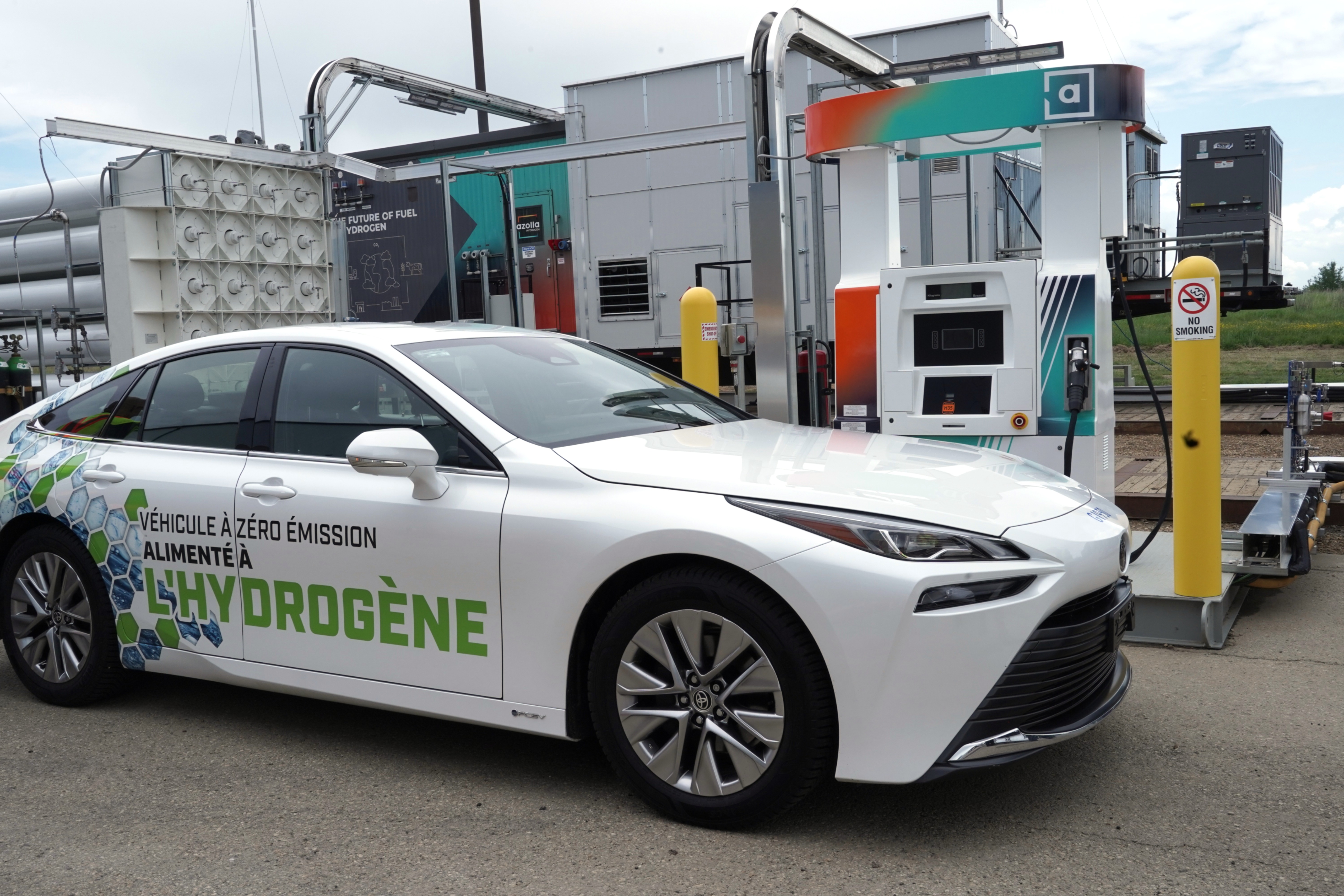
Deploying two mobile hydrogen fueling stations to supply hydrogen-capable municipal fleet vehicles during the testing phase of low-emissions alternatives. The first station, the Azolla Biodrome, became operational at the City's Ellerslie Facility in June 2025, producing on-site hydrogen from methanol and deionized water.
Why it matters
Addresses one of the key early barriers to hydrogen adoption: the lack of reliable fueling infrastructure. The project fuels hydrogen fuel cell cars, a fuel cell electric transit bus, dual fuel transit buses, semi-trucks, and waste collection trucks.
Partners
City of Edmonton, Strathcona County, Sturgeon County, Alberta Motor Transport Association, Emissions Reduction Alberta, Transition Accelerator Inc., University of Alberta, Government of Alberta, Diesel Tech Industries, Azolla Hydrogen Ltd.
Key facts
Project value
$6.9 million
Funding
Emissions Reduction Alberta (ERA)
Mobility focus
Municipal fleets, transit buses, semi-trucks, waste collection trucks
Infrastructure
Construction of two mobile hydrogen fueling stations
Operational since
June 2025
Number of Associated Vehicles
8+ (City of Edmonton: 3 Nexo, 2 Mirai, 1 FCEV Bus, 1 Dual Fuel Bus, 1 Waste Refuse Truck; plus Gov. of Alberta 3 Mirai, Edmonton Global 1 Mirai)